Bet the Major Leagues Offshore Where the Lines Are Sharp All Season
The four major North American sports calendars (gridiron, basketball, baseball, hockey) overlap across the year; the offshore bettor reads them as one vertical with sport-specific edge windows rather than four separate disciplines.
Pro basketball and pro baseball pay the largest absolute edge across a season; gridiron pays the largest single-bet limit; hockey pays the most consistent per-bet edge for the disciplined player.
The college versions of gridiron and basketball are the deepest soft-line markets in North American sports betting; mid-major conferences carry edges that the pro versions of the same sports rarely show.
In-play depth varies sharply by sport; basketball and baseball trade continuously, gridiron trades between plays, hockey is best treated as a pre-game vertical with selective in-play exposure.
The operator stack covers all four sports with at most three operators: a reduced-juice market maker, a sharp-tolerant fixed-odds book, and a prop-deep operator for the algorithmic prop pool.
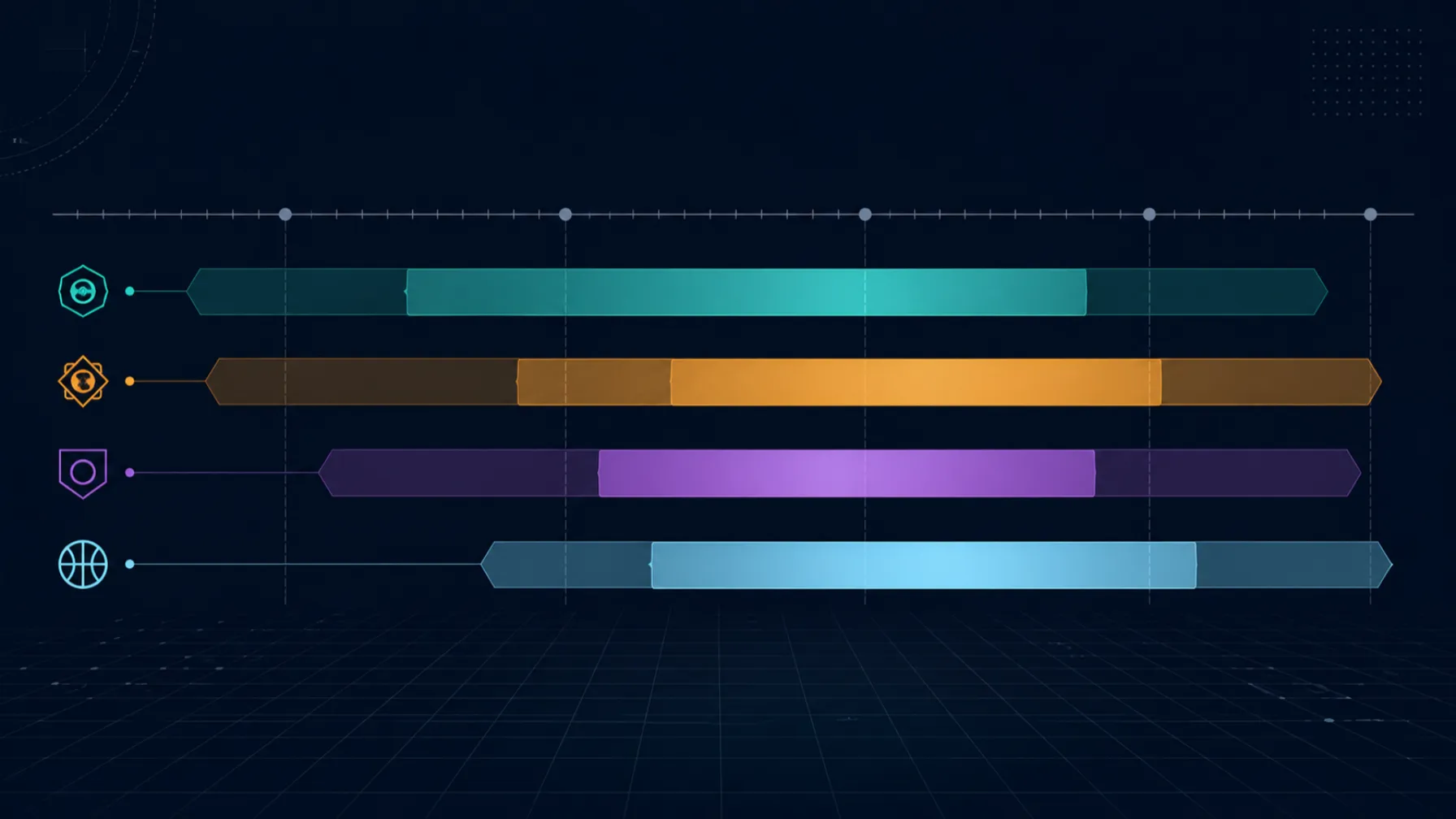
Four major-league calendars overlap across the year on offshore books; the bettor reads the sport-by-sport edge calendar to allocate season volume.
Why major-league offshore betting is one strategy, not four
The major-league bettor on offshore books is reading a calendar, not a sport. Pro gridiron runs August through January (regular season plus playoffs). Pro basketball runs October through June. Pro baseball runs April through October. Pro hockey runs October through June. The four calendars overlap in three distinct phases each year: a deep winter window where basketball and hockey share the schedule with gridiron playoffs, a spring window where basketball and hockey playoffs run with the start of baseball, and a summer window dominated by baseball with the supporting role taken by gridiron preseason. The disciplined bettor allocates bankroll, attention and operator-stack management across the calendar rather than treating each sport as an isolated discipline.
The economics make the calendar the unit of analysis. A regular-season pro basketball game pays a small per-bet edge (1 to 3 percent on sides line shopping, 2 to 5 percent on prop selection) but the season runs roughly 1,230 regular-season games; the cumulative edge compounds across volume. A pro gridiron regular-season game pays a larger per-bet edge (3 to 6 percent on sides, 5 to 10 percent on totals) but the regular season runs 272 games; the per-game edge multiplies against a smaller volume. Pro baseball runs 2,430 regular-season games at a moderate per-bet edge concentrated in the totals market. Pro hockey runs roughly 1,300 regular-season games at the most consistent per-bet edge but the smallest absolute return per game. The bettor that reads the per-sport edge profile, multiplied by the per-sport volume, allocates the season’s bankroll where the absolute return is highest.
The offshore advantage stretches across all four. The reduced-juice books deliver structurally tighter prices on every sport (typically 5 cents on sides instead of the 10 to 20 cents on regulated alternatives); the prop-deep operators deliver a prop tree multiple times wider than the regulated alternative; the sharp-tolerant operators take the action at sizes the regulated books pull within a few weeks of positive CLV. The structural disadvantage of betting these sports on a regulated book is documented across the entire site; the question this page answers is how to bet them offshore once the operator stack is in place. The pillar on the offshore sportsbooks page covers the operator product side; the operator-corporate side, including license and trading-desk diligence, lives on the offshore bookmakers pillar; this page covers the sport-by-sport play.
Concept primer: the sport-by-sport edge calendar
The chart below maps the four major North American sports across the calendar months of the year against the typical edge window for the disciplined bettor. The axes are: months active, average per-bet edge captured by line shopping, average per-bet edge captured by prop selection, and approximate game count per regular-season month. The pattern is consistent across multiple seasons but the absolute edge values vary year over year as the operator pool evolves.
Sport-by-sport edge profile across the calendar (indicative, regular season)
Label
Avg per-bet edge from line shopping (percent)
Avg per-bet edge from prop selection (percent)
Approx games per regular-season month
Posted limit on marquee side (USD thousand)
Pro gridiron
4
6
60
50
Pro basketball
2
4
200
25
Pro baseball
3
4
400
15
Pro hockey
2
3
220
10
Pro gridiron pays the largest per-bet edge and the highest posted limits; pro baseball and pro basketball pay smaller per-bet edges across far higher volume.
Three reads from the chart. First, the per-bet edge ranking inverts against the volume ranking; gridiron is the highest per-bet but the lowest volume, baseball is the lowest per-bet (after hockey) but the highest volume. Second, the prop-edge bar exceeds the line-shopping bar on every sport; the prop tree is structurally softer than the headline sides market across the offshore operator pool. Third, the posted-limit bar tells the bettor where the bankroll fits; the bettor with serious size on gridiron can deploy capital in a way the same bettor on hockey or baseball cannot. The strategic implication is that the bankroll allocation per sport should weight per-bet edge times volume, with the limit ceiling as a constraint on the deployment side.
The seasonal allocation. From August through January, the gridiron volume dominates; the bettor concentrates roughly 35 to 45 percent of the year’s active bankroll on gridiron sides and totals across the regular season, with the remaining bankroll spread across the basketball and hockey starts. From January through April, the basketball and hockey regular seasons run alongside the gridiron playoffs; the bettor shifts to a basketball-and-hockey-heavy mix with a small gridiron playoff allocation. From April through August, baseball is the primary vertical with basketball and hockey playoffs filling the early months; the bettor concentrates roughly 35 to 45 percent of the active bankroll on baseball totals. The college versions of gridiron and basketball overlay this calendar and run their own edge windows that the disciplined bettor incorporates into the allocation.
Pro gridiron: the highest-limit, highest-attention market
Pro gridiron is the marquee North American betting market. Every regular-season Sunday delivers a 10 to 14 game slate with high handle, high public attention, and the most-traded sides and totals lines in the offshore market. The operator margin on a Sunday afternoon side is structurally 4 to 5 cents on the reduced-juice books and 6 to 8 cents on the mainstream offshore operators; the totals market runs slightly wider but with sharper line moves through the week as injury news lands. The bettor with a model finds edges on the early-week opening lines (when the algorithmic open precedes the sharp money) and on the late-week closing lines (when the public side has been hammered and the value crosses to the contrarian side).
The prop tree on pro gridiron is the deepest in North American sports. Player passing yards, rushing yards, receiving yards, touchdowns scored, completions, sacks, defensive props, special-teams props, and exotic combinations all run through the operator algorithm with uneven trader attention. The operator algorithm rarely conditions on game-script signals (a heavy underdog will throw more, a heavy favorite will run more in garbage time); the bettor with a script-based model finds prop edges on most slates. The capture rate is highest on the props of secondary players (receivers below the lead options, backup running backs in a committee, defensive players outside the marquee names); the trader attention concentrates on the headline names, the algorithm prices the rest.
The college gridiron market deserves a paragraph. The operator allocates trader attention to the top conferences (the so-called power conferences) and lets the algorithm price the mid-major conferences with minimal review. The pricing on mid-major matchups carries 5 to 8 percent margin against 3 to 4 percent on the headline matchups, and the line moves slowly through the week as injury news lands. The bettor with a mid-major model finds the deepest persistent edge in North American sports betting on the offshore book; the per-bet edge clears 6 percent on average and the volume per Saturday is high (40 to 60 mid-major games most weekends). The trade-off is the limit ceiling; mid-major sides carry posted limits at 1,000 to 5,000 USD on most operators, the bettor cannot deploy capital at the same rate as on the pro market.
Worked example one: capturing the closing line on a regular-season pro gridiron Sunday
The bettor runs a model that produces a fair price on every game on a Sunday slate. The bettor opens the operator stack on Tuesday morning when the early lines are posted: the reduced-juice market maker has prices at 4 cents juice (typical 1.91 / 1.91 sides, the equivalent in the bettor’s preferred odds format), the sharp-tolerant fixed-odds book at 5 cents juice, the mainstream offshore operator at 8 cents juice. The bettor compares the posted line on each game to the model fair line.
Three games on the slate show meaningful divergence. Game one: the reduced-juice book has Team A at -3 -110, the model fair line is -2.5 -110. The bettor takes Team B at +3 +105 (B value at 1.5-point inflation plus the +5 cent edge from the line). Game two: the operator stack consensus is -7 across the books, the model fair line is -8.5. The bettor takes Team C at -7 -105 for the 1.5-point edge plus the 5-cent juice differential against the consensus. Game three: the sharp-tolerant book has Team D at -10 +100, the mainstream offshore operator has Team D at -10 -110. The bettor takes Team D at -10 +100 for the 10-cent line shopping edge.
The closing line on each game by Sunday morning. Game one closes at A -2.5 -110 (the bettor’s position closes on the right side of the line, the bettor captured 0.5 points and the price differential, total realised edge on settlement roughly 4 percent). Game two closes at -8.5 -110 (the bettor captured 1.5 points and the juice differential, total realised edge roughly 7 percent). Game three closes at D -10 -110 (the bettor captured 10 cents of price, total realised edge roughly 5 percent). Across the three bets at 500 USD stake each, the expected return is 1500 * 5.3 percent = 80 USD above zero-edge baseline.
The math across a season. The bettor places roughly 30 to 40 such bets per regular-season week across 17 weeks. The per-bet expected edge averages 4 percent (some bets larger, some smaller). At 500 USD average stake, the season-long expected return is 35 bets * 17 weeks * 500 * 0.04 = 11,900 USD. The variance is moderate (sides bets have a roughly 50 percent hit rate at fair pricing, the realised return tracks expectation within a 30 percent band by season-end on a disciplined operator). The realised return after operator-fee friction (cashier costs, rail spreads on funding) lands at roughly 9,000 to 11,000 USD on a 250,000-USD season-long handle. The line-shopping discipline is the strategy; the model is the input, the operator stack is the deployment vehicle.
Worked example two: a pro baseball totals edge on a hot summer slate
The slate is a typical summer evening with 12 games on the pro baseball board. Five of the games have starting pitchers with materially different season-long performance against the lineups they face; the operator algorithm prices the totals on the season-long pitcher-versus-lineup matchup but does not always condition on the recent form (last four starts, recent velocity, recent home-run rate against the lineup’s archetype). The bettor with a recent-form model identifies three games where the operator’s posted total diverges from the model fair total by 0.5 runs or more.
Game one: posted total 8.5 over -110 / under -110. The bettor’s model fair total is 9.0; the over at -110 is a 5 percent positive edge bet. Game two: posted total 9.5 over -110 / under -110. The bettor’s model fair total is 9.0; the under at -110 is a 5 percent positive edge bet. Game three: posted total 7.5 over +100 / under -120. The bettor’s model fair total is 8.0; the over at +100 is a 7 percent positive edge bet (a half-run plus the price differential against the line vig).
The bettor places three bets at 200 USD stake each. Expected return on the three bets: 600 * 5.7 percent = 34 USD. Across a typical week of seven slate days with three to five edge bets per day, the bettor places 25 to 30 bets a week at 200 USD stake. Per-week expected return: 28 * 200 * 0.055 = 308 USD. Across the 26-week regular season, the expected return on baseball totals alone is 8,000 USD, layered on top of the per-bet edge from the line-shopping rotation already covered on the reduced-juice page. The variance on totals bets is large (totals settle on a single game outcome with a moderate fair-line probability), but the realised return tracks expectation within a 35 percent band by season-end.
The discipline. The bettor scans the entire slate every day and places bets only on games where the model edge clears 4 percent. The bettor does not chase action on games without a model edge; the disciplined "no bet" call on most games is what separates the line-shopping bettor from the daily-action bettor. The latter pays the structural margin on every bet placed, the former pays it only on the bets where the edge justifies the cost. Across a season, the per-bet edge premium of the disciplined bettor over the daily-action bettor compounds to a meaningful absolute return on the same bankroll.
Pro basketball: the deepest in-play market and a fertile prop tree
Pro basketball is the most tradable in-play market in offshore betting. The operators run continuous in-play with sub-second odds refresh on the live moneyline, the live total, the live spread, and a wide set of micro-markets (next basket scored, points in the next minute, leader at the next quarter). The pre-game prop tree is similarly deep: player points, player assists, player rebounds, three-pointers made, double-doubles, triple-doubles, and a long tail of combination props that the operator algorithm prices without trader review on most regular-season games.
The structural edge for the disciplined bettor lives in two zones. The pre-game prop pool on regular-season games carries 4 to 7 percent margin and stale numbers that have not been adjusted for back-to-back fatigue, lineup-news (a star player doubtful, a backup elevated to starter), or pace-of-play matchups. The in-play prop pool runs even softer in the second halves of blowout games where the operator’s algorithm continues to price props on the original game-script assumption while the actual game has shifted into a garbage-time pattern. The bettor that reads the game flow and acts in the third quarter on the divergence books edges that the algorithm-only operator never adjusts.
The pace-of-play factor is a specific and persistent edge. Two teams with a high possessions-per-game baseline play a faster game with more total points; the operator algorithm prices the total on the season average baseline of both teams without conditioning on the matchup-specific pace. The bettor with a pace model finds 3 to 5 percent edges on the totals on roughly a third of all games; the discipline is to scan the slate every game day, identify the pace-divergent matchups, and place the totals bet at the operator with the most stale algorithmic price. The volume across a six-month regular season at three to five bets per day produces a meaningful absolute return for the model-driven bettor.
Pro hockey: the under-followed sport with a consistent edge
Pro hockey is the smallest absolute return of the four major sports but the most consistent per-bet edge for the disciplined player. The operator allocates the least trader attention to hockey of the four sports; the algorithmic pricing carries the bulk of the workload, and the algorithm rarely conditions deeply on goalie matchups, line combinations, or special-teams metrics. The bettor with a hockey model finds 2 to 4 percent edges on the moneyline and 3 to 5 percent edges on the puck-line and totals markets across most regular-season games.
The goalie-specific edge is the largest single source of positive expected value in offshore hockey betting. A backup goalie starting in place of the regular starter shifts the team’s expected goals against by 0.3 to 0.6 goals per game; the operator algorithm prices the line on the team’s baseline goalie performance without always adjusting for the late-day starter announcement. The bettor that reads the morning skate news (typically published 4 to 6 hours before puck drop) and acts within the first hour of the news landing captures the structural mispricing. The capture rate is high because the news is publicly available; the operator algorithm simply does not always update the line in real time.
The hockey prop tree is shallow compared to the other three sports; the bettor finds edges on the player-shots props and on the goal-scorer props, but the volume per game is small and the operator limits on these markets are typically 100 to 500 USD per bet. The hockey strategy concentrates on the moneyline and puck-line where the limits are higher (1,000 to 10,000 USD on most operators) and the per-bet edge is consistent. The bettor that runs hockey alongside basketball through the winter doubles the operator-stack utilization without doubling the workload because the same operator pair handles both sports.
The rare tactic: cross-sport correlation and the simultaneous-slate bet portfolio
The standard major-league bettor places bets on individual games one at a time and sizes each bet on its standalone edge. The disciplined bettor reads the simultaneous slate as a portfolio and looks for cross-sport correlation that smooths the variance of the season’s aggregate position. The rare-tactic angle is to combine bets across the four sports on a single evening (a winter Tuesday with basketball, hockey, and college gridiron all on the slate) into a portfolio that hedges the sport-specific variance through diversification.
The mechanic. The bettor identifies three to five positive-edge bets across the simultaneous slate on different sports. The bets are statistically uncorrelated (a basketball totals bet does not move with a hockey moneyline bet does not move with a college gridiron sides bet); the variance of the portfolio is the square root of the sum of squared variances rather than the sum of variances. The portfolio Sharpe ratio (expected return divided by standard deviation) is materially higher than any single bet’s Sharpe ratio. The bettor sizes the portfolio bet pool at a higher fraction of the bankroll than any single sport’s bet pool would justify because the diversification reduces the portfolio risk.
The capture across a season. The simultaneous-slate portfolio runs roughly four nights a week through the winter (three sports overlapping), three nights a week in the spring (basketball, hockey, baseball), and two nights a week in the summer (baseball plus college gridiron in the late summer). The portfolio approach lifts the bettor’s realised return per dollar of bankroll deployed by 10 to 20 percent against the same bettor placing the same individual bets without the portfolio framing, because the diversification allows higher per-night deployment without the variance penalty. Most competing pages on major-league offshore betting skip this section because the affiliate economics steer the writing toward "pick the best operator for sport X" rather than "deploy across the simultaneous slate"; the portfolio read is the angle the SERP misses.
The skip condition. The portfolio approach works only when the bettor has positive-edge bets across at least two sports on the same evening; on slates without simultaneous edges, the bettor falls back to the single-bet sizing on the one sport where the model edge clears the threshold. The discipline is to size to the standalone edge when only one sport has bets and to size up to the portfolio edge when multiple sports have bets; the differentiation is what makes the approach work without over-deploying on thin nights.
Pitfalls: the failure modes that turn a major-league strategy into a loss
Single-sport over-concentration. The bettor that bets only one of the four major sports without seasonal diversification underutilizes the calendar and exposes the bankroll to sport-specific variance windows. A poor stretch in one sport (a 30-game cold streak in basketball, a series of weather-disrupted baseball games, a string of unfavorable injuries in gridiron) lands the season’s return in a hole that the bettor cannot recover from within the same sport. The mitigation is the calendar-allocation discipline above and the willingness to bet at least three of the four sports across the year even at lower volume on the secondary sports.
Closing-line value misreading. The bettor that focuses on the bet result rather than the closing line value misreads the strategy’s health. A bet that lands at 1.5 points of CLV on a winning bet is not worth more strategically than the same bet at 1.5 points of CLV on a losing bet; the variance washes out across a hundred-bet sample, the CLV signal does not. The mitigation is a discipline of tracking CLV per bet rather than profit-and-loss per bet, and a willingness to evaluate the strategy on the CLV metric across at least 200 bets before drawing conclusions.
Prop-pool over-reach. The bettor that places prop bets across every game on every slate without a model on the specific prop type pays the structural margin without the offsetting edge. A 5 cent vig on a player-points prop is a 5 cent tax per bet without a model that identifies the systematic mispricing; the bankroll mathematics that govern this kind of fractional-edge volume sit on the arbitrage and +EV page; the bettor that places 50 prop bets a week without model edges loses the equivalent of 2.5 sides bets a week to vig alone. The structural pitfall is the same as the bonus-rollover trap covered on the bonuses page; volume without edge is a tax, not a strategy. The mitigation is to place prop bets only on prop types where the bettor’s model has documented historical edge, and to skip the prop tree on bets without model coverage.
In-play timing exploitation. The bettor that attempts to place an in-play bet during a market suspension or in the seconds before the operator’s feed catches up to a live event walks into a void on most operators. The mainstream offshore operators void aggressively on bets accepted within the suspension window; the Asian-style and reduced-juice operators run too tight a feed for the gap to exist systematically. The mitigation is to skip the lag-arbitrage angle and bet the in-play market on price reading rather than timing exploitation. The live betting page covers the in-play methodology in detail.
Limit reduction on the sharp side. The bettor that runs sustained positive CLV across the four sports on a single operator triggers the operator’s sharp-account flag and faces silent limit reductions on the markets where the bettor has shown the most edge. The mitigation is the operator-pair rotation (at least two operators per sport, three operators across the four sports) and the bankroll discipline of the high-limit page; the rotation extends the life of the bettor’s account at posted limits and protects the season-long deployment plan.
Futures-market over-investment. The bettor that ties up bankroll on futures markets at the start of the season locks the capital across the entire season at a lower marginal edge than the in-season individual game market. A 5 percent edge on a futures bet at 8 percent operator margin compares unfavorably to a 4 percent edge on a same-week individual game at 4 percent operator margin once the time-value of the locked capital is factored in. The mitigation is a futures cap of 10 to 15 percent of the season-start bankroll and a reservation of the rest for in-season game-by-game deployment.
Public-side fade misreading. The bettor that automatically fades the public side without a model read on the actual game often pays the structural margin without the offsetting edge. The public side wins roughly half its bets at fair pricing; the contrarian play has a small edge from the operator’s line shading toward the public side, but the edge is only 1 to 3 cents on the line and is fully consumed by the vig on most bets. The mitigation is to use the public-side signal as a marginal adjustment to the model rather than a stand-alone bet thesis, and to require the model edge to clear the threshold before placing the contrarian bet.
Frequently asked questions
Which of the four major leagues pays the largest offshore edge over a season?
Pro basketball and pro baseball pay the largest absolute edge for the disciplined bettor, for different reasons. Pro basketball delivers a long regular season with a high game count and well-developed prop trees that operators price algorithmically; line-shopping and prop-edge capture compound across roughly 1,200 regular-season games. Pro baseball delivers a structurally inefficient totals market with weather, ballpark and starting-pitcher variance that operators do not always price tightly; the bettor with a totals model finds 3 to 5 percent edges on most days. Gridiron pro pays a smaller per-game edge on a smaller game count but the biggest single-bet absolute return because the limits are highest. Hockey is the smallest absolute return but the most consistent per-bet edge for the disciplined player.
Why do regulated domestic operators struggle to compete on these sports?
Three structural reasons. The juice on regulated books on these sports is consistently higher (typically 10 cents on sides versus 4 to 6 cents on offshore reduced-juice operators); the prop pool is shallower (regulated books publish a fraction of the props offshore operators offer); and the limits on sharp accounts on regulated books are pulled aggressively after a few weeks of positive CLV. The structural disadvantage compounds across a full regular season: the same bettor with the same model nets dramatically less on a regulated book than on an offshore stack with two to three operators in rotation. The reduced-juice and prop-depth gaps are documented on the line shopping page and the sportsbooks pillar.
How should I split action across the four sports calendars in a year?
The calendar approach drives the answer. Pro gridiron runs roughly 17 weeks regular season plus playoffs; the bettor concentrates the bulk of football action across those weeks. Pro basketball and hockey run October through April overlapping; the bettor manages two simultaneous regular seasons through the winter. Pro baseball runs April through September; the bettor shifts focus to baseball after the basketball and hockey playoffs. The smart split is sport-weight by personal model strength rather than uniform allocation: the bettor with a strong baseball totals model concentrates 40 to 50 percent of the season’s bankroll there in the summer, the bettor with a basketball props edge concentrates 40 percent across the winter, and so on.
Are college-level versions of these sports worth betting offshore?
College gridiron and college basketball are the deepest soft-line markets in North American sports betting. The operator allocates the bulk of trader attention to the top conferences and lets the algorithm price the rest; the bettor with a model that covers the mid-major and lower-tier conferences finds 4 to 10 percent edges with regularity, well above the per-bet edge on the pro versions of the same sport. The trade-off is volume per game and limits per game; a college mid-major sides line carries posted limits at 1,000 to 5,000 USD on most operators, against 50,000 USD on a pro headline market. The college edge is real but the absolute return per bet is smaller; the bettor with the time to scan the full schedule realises the edge, the bettor that bets on the headline games only does not. The funding rotation that supports cross-operator deployment without paying the rail spread on every transfer is covered on the payments page.
How do in-play markets compare across the four sports?
Pro basketball and pro baseball run the deepest in-play markets; the operators trade these continuously through the game with sub-second odds refresh, frequent micro-markets (next made shot, next pitcher change, run line in the half-inning) and narrow suspension windows. Pro gridiron in-play is constrained by the play-by-play structure; markets suspend between every play and the operator refreshes during the natural pauses. Hockey in-play is the thinnest of the four; the goal-event suspension windows are wide and the prop pool during play is small. The strategic implication is that basketball and baseball are tradable in-play across most major operators, gridiron is tradable but with workflow constraints, hockey is best treated as a pre-game vertical with selective in-play exposure.
Should I bet futures and division winners offshore versus regulated options?
Yes if the bettor has a futures-specific edge, otherwise no. The futures market on offshore books is priced wider than the in-season individual game market because the operator capital is tied up for months and the operator hedges the position by widening the price; the typical operator margin on a division-winner future is 15 to 25 percent against 4 to 6 percent on a same-week game. The bettor with a futures model finds edges on long-tail outcomes (mid-tier division winners that the public ignores) and the bettor without a futures model overpays the structural margin without the offsetting edge. The default rule for the recreational bettor: stick to in-season game markets where the operator margin is structurally tighter.
We use necessary cookies to make this site work. We would also like to set optional analytics cookies to understand how visitors use the site. You can change your choice at any time from the footer.